
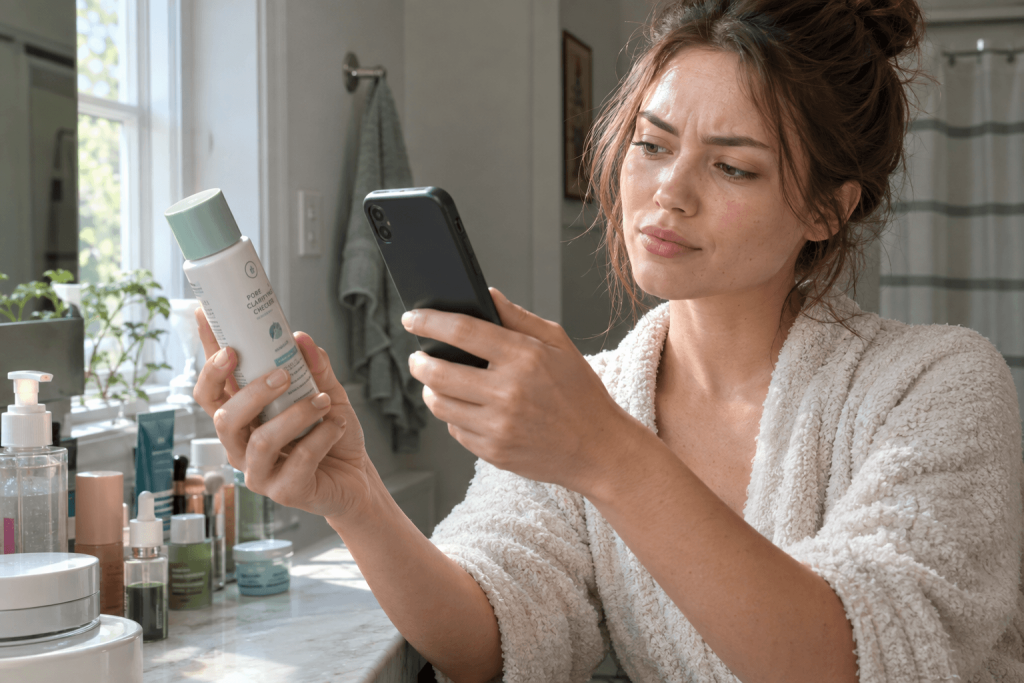
The pore clogging checker product search is for people who want a fast way to see if a specific skincare or makeup item may clog pores. ReadLabel helps you check the actual product, flag pore-clogging risk, and decide whether it looks acne-safe before you buy or use it.
Check the product, not just the ingredient theory
A product ingredient checker is most useful when you are standing in front of a real item and asking, “will this clog my pores?” ReadLabel is built for that moment. It analyzes the INCI ingredient list on the package, so you can evaluate the finished product instead of guessing from marketing claims.
This is especially helpful for acne-prone skin and anyone looking for non-comedogenic skincare or a more sensitive skin friendly routine. You get a clear pore-clogging risk assessment without having to decode the formula yourself.
How to check a skincare product instantly
The fastest workflow is simple. ReadLabel is designed to reduce friction and get you an answer quickly on mobile.
- Take a photo of the ingredient list.
- Upload an existing photo of the label.
- Scan the ingredient list with your camera.
- Scan the product barcode where relevant.
- Review the flagged ingredients and the risk call.
That makes it a practical skincare product checker for in-store shopping, at-home routine checks, and last-minute “is this acne safe?” decisions.
What the checker shows after a scan
A good comedogenic checker should not just say yes or no. It should show why a product may be a concern.
ReadLabel identifies the flagged ingredients inside the formula and highlights what may contribute to pore clogging. That helps you see the specific parts of the product that matter, instead of relying on a vague label claim.
Common categories that often get flagged in product-level checks include:
- Heavy occlusive ingredients
- Rich emollients
- Waxy formula components
- Certain additives that may be a fit issue for breakout-prone users
That does not mean every flagged product will break you out. It means the formula deserves a closer look before you commit.
Why product-level checking is better than guessing
Two products can contain the same ingredient and still behave differently. Concentration, formula balance, and whether the item is leave-on or rinse-off all affect the final result.
That is why a pore-clogging product checker is more useful than a single-ingredient search. It helps you judge the whole formula outcome, not just one line on an ingredient list.
If you want the broader ingredient-focused version, you can also use the pore clogging checker for deeper product and ingredient review.
Why results can differ across tools
Different databases may flag different ingredients, or rank the same product differently. That usually happens because tools use different reference data, scoring rules, and ingredient coverage.
With ReadLabel, the goal is transparency. You can see what was flagged and why the result leans one way or another. That is better than a black-box answer when you are trying to avoid hidden pore cloggers.
Reasons tools may disagree include:
- Different ingredient databases
- Different interpretations of comedogenic ingredients
- Different handling of concentration and formula context
- Different product coverage and freshness
What “pore clogging” and “comedogenic” mean here
In this hub, pore clogging and comedogenic both refer to ingredients or formulas that may increase the chance of clogged pores for some users. They are directional signals, not absolute predictions.
That is the right mindset for purchase decisions. A non-comedogenic checker can help you reduce risk, but no tool can guarantee that a product will never cause a breakout.
Important limits before you buy
No checker can promise perfect skin outcomes. Even a product that looks fine on paper can still cause breakouts because skin type, routine, and usage patterns vary.
Use the result as decision support, not a medical verdict. If a product looks borderline, the safest move is to compare it against other options before you buy or apply it.
Why ReadLabel fits mobile shopping better than old desktop tools
Many checker pages feel desktop-first, slow, or database-heavy. ReadLabel is designed for quick scanning on a phone, which fits how people actually shop for skincare now.
That matters when you are in a store, looking at a product photo online, or trying to decide whether to open a new item tonight. Fast access, simple language, and clear flagged ingredients make the process less stressful.
Fast answers for acne-prone shoppers
If your routine goal is to stay acne safe, non-comedogenic, and less likely to trigger surprise breakouts, a product checker can save you from bad buys. It is one of the quickest ways to screen for hidden pore-clogging risk before you commit.
ReadLabel is built for users who want:
- A faster way to check skincare and cosmetic products
- A simple scan-first workflow
- Clear ingredient flagging
- More confidence before purchase or use
- Less guesswork around hidden pore cloggers
Try it with ReadLabel
If you want to check a product now, open ReadLabel and scan the ingredient list from a photo. You will get a clearer view of whether the formula may be pore clogging, acne-safe, or worth skipping.
The app includes a 3-day free trial, so you can test the workflow before deciding whether it fits your routine.
FAQ
How do I know if a product is pore clogging?
The fastest way is to scan the product’s ingredient list with ReadLabel and review the flagged ingredients. If the formula shows multiple higher-risk ingredients, it may be more likely to clog pores for acne-prone users.
Is there an app to check comedogenic ingredients?
Yes. ReadLabel is a skincare ingredient checker app that scans ingredient lists from photos and helps you check for pore-clogging risk before buying or using a product.
Are pore-clogging ingredient checkers accurate?
They are useful, but they are not perfect. Accuracy depends on the database, the formula context, and how the tool interprets comedogenic ingredients, so results should be treated as directional rather than absolute.
What does non-comedogenic really mean?
It means a product is intended to be less likely to clog pores, but it is not a guarantee. A non-comedogenic product checker helps you lower risk, not eliminate it completely.
Can a product be non-comedogenic and still cause breakouts?
Yes. A product can be labeled non-comedogenic and still cause breakouts for some people because skin reacts differently to formula balance, irritation, or routine overlap. That is why product-level scanning is still useful.
Can I scan a product without typing anything in?
Yes. ReadLabel lets you take a photo or upload an ingredient list image, and you can also scan a product barcode where relevant. That keeps the workflow quick on mobile.